Why Your DPR Gets Rejected: 6 Common Mistakes That Delay Infrastructure Project Approvals
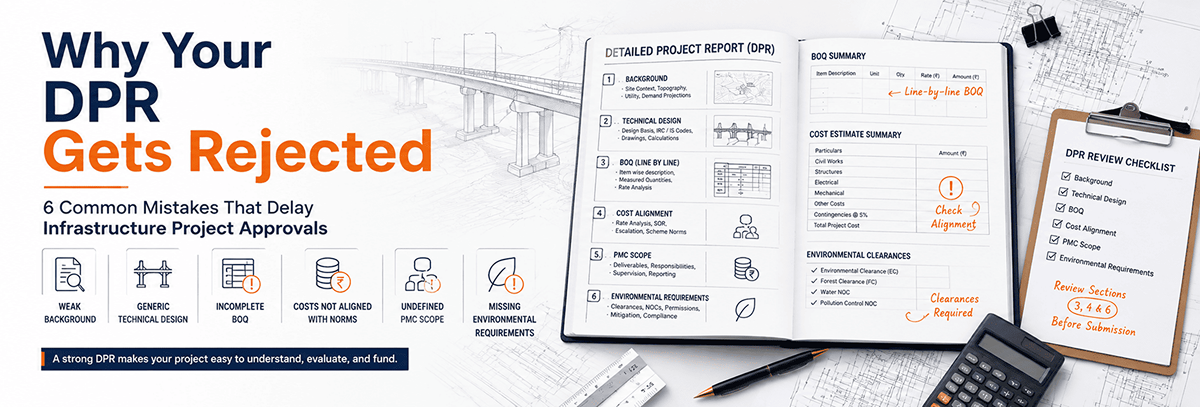
A Detailed Project Report (DPR) is much more than a project document—it is the foundation for project approval, funding, and execution. Yet many infrastructure projects face unnecessary delays because of avoidable mistakes in their DPR.
At Stambha Consultants, we've seen that DPR rejection is rarely caused by one major issue. Instead, it usually happens because several small but critical sections are incomplete, inconsistent, or unsupported by technical evidence.
If you're preparing a DPR for roads, bridges, buildings, water supply, urban infrastructure, or government-funded projects, understanding these common mistakes can significantly improve your approval chances.
Why Do DPRs Get Rejected?
Funding agencies, government departments, and technical reviewers don't simply verify whether every chapter exists. They evaluate whether the document provides enough clarity to confidently approve and finance the project.
The most common reasons for rejection include:
- Weak project background
- Generic technical design
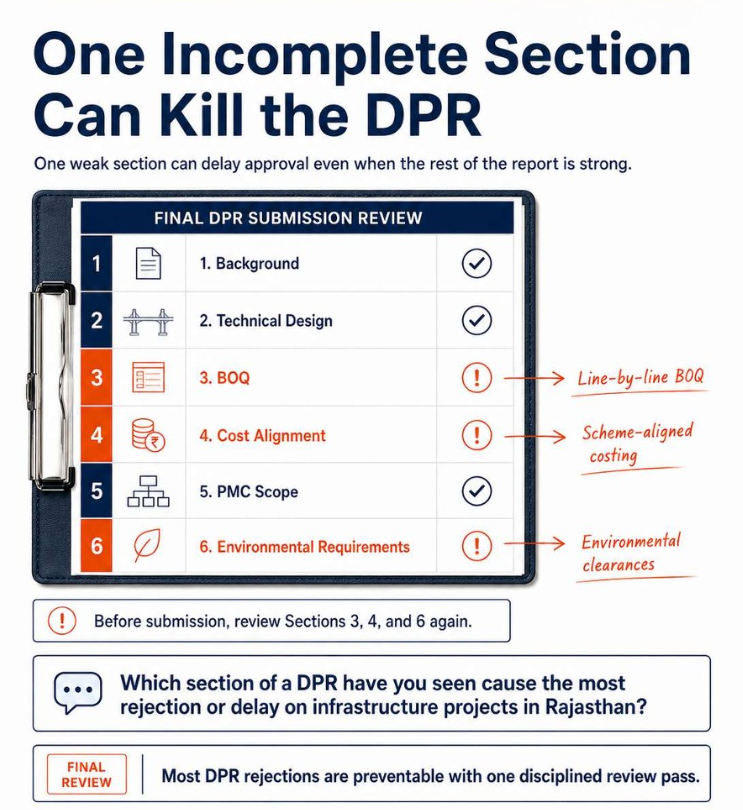
- Incomplete Bill of Quantities (BOQ)
- Cost estimates not aligned with scheme norms
- Undefined PMC (Project Management Consultant) scope
- Missing environmental clearances and compliance documents
A strong DPR should make the project easy to understand, evaluate, and fund—not simply appear complete.
1. Weak Project Background
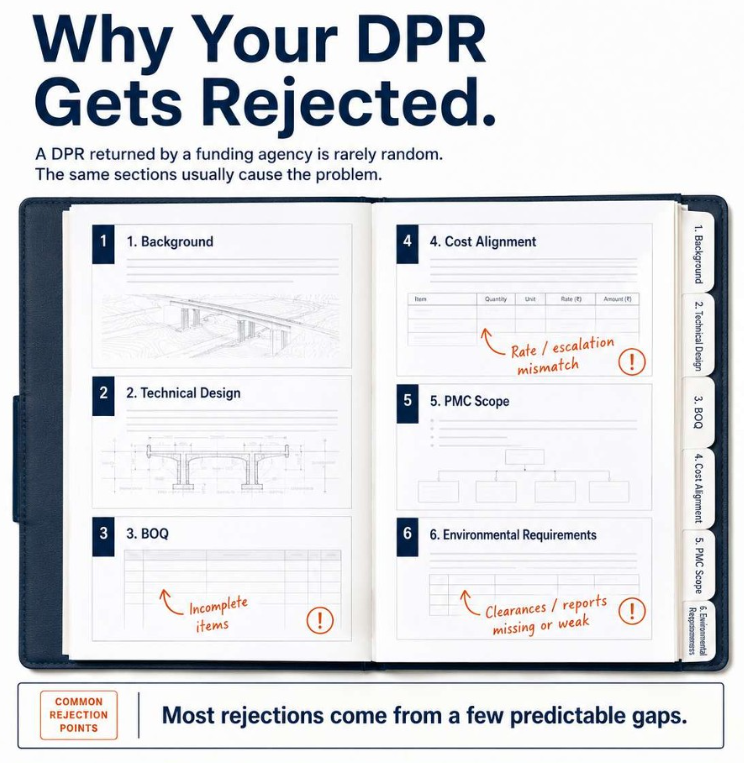
Every successful DPR begins with a clear understanding of the project context.
Unfortunately, many reports only include a few paragraphs describing the project without presenting the actual site conditions.
A strong background section should include:
- Site location and project context
- Existing infrastructure conditions
- Topographical information
- Utility constraints
- Demand projections
- Supporting maps and surveys
When the background lacks actual field data, reviewers often question the necessity and feasibility of the proposed project.
2. Generic Technical Design
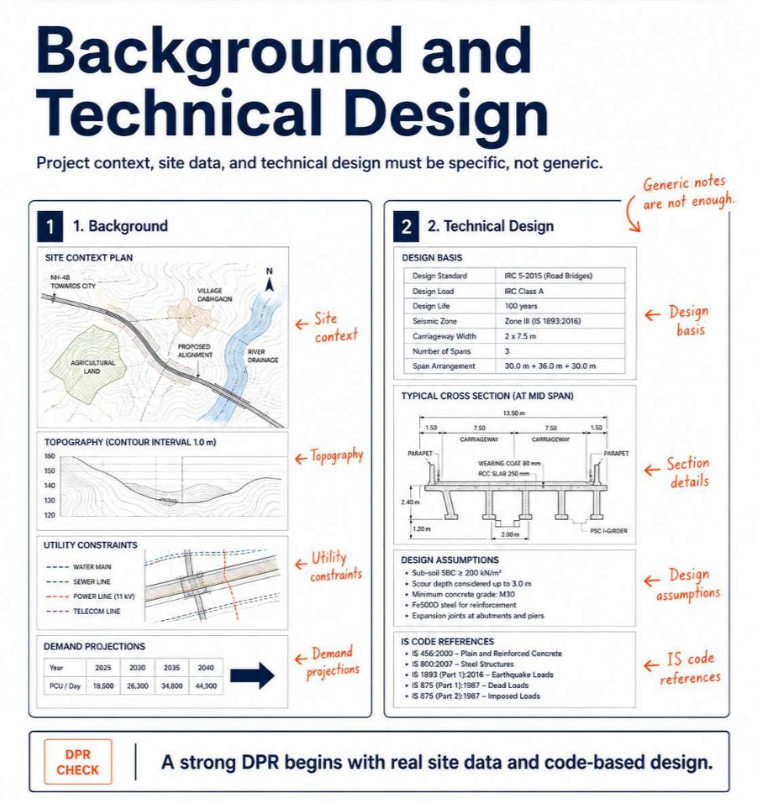
One of the biggest reasons technical reviewers return a DPR is the use of generic design notes copied from previous projects.
A proper technical design should clearly explain:
- Design standards followed
- Applicable IRC/IS Codes
- Design assumptions
- Structural calculations
- Cross-sections
- Material specifications
- Load considerations
- Site-specific engineering decisions
The technical section should be backed by:
- Actual site investigation
- Design assumptions
- Relevant IS & IRC code references
- Engineering calculations
Remember:Generic notes are never enough for infrastructure approvals.
3. BOQ Must Be Line by Line
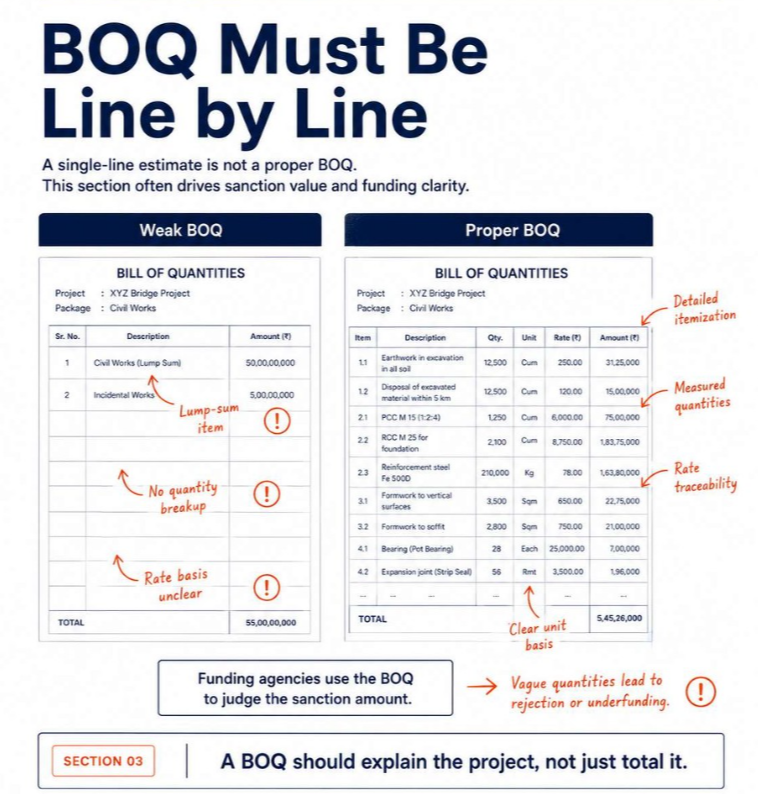
The Bill of Quantities (BOQ) is often the deciding factor for funding approval.
Many DPRs fail because the BOQ contains only lump-sum values without explaining what those amounts represent.
A proper BOQ should include:
- Item-wise description
- Measured quantities
- Units
- Rate analysis
- Amount
- Clear basis of measurement
A detailed BOQ improves transparency, simplifies technical review, and increases funding confidence.
4. Cost Estimates Must Align with Scheme Norms
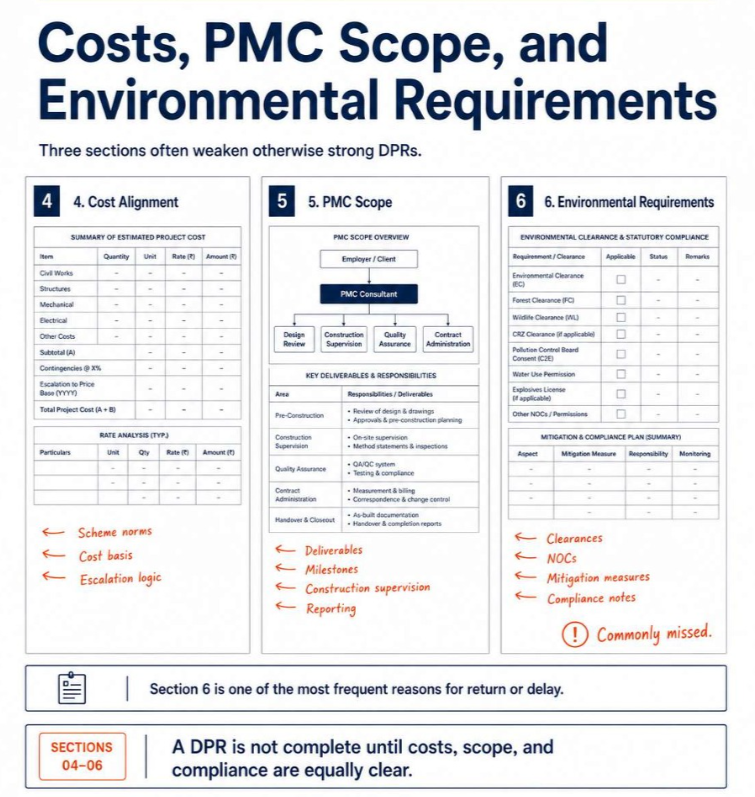
Even technically sound projects may face rejection if the costing lacks proper justification.
Your DPR should explain:
- Cost basis
- Schedule of Rates (SOR)
- Escalation methodology
- Scheme guidelines
- Contingencies
- Project cost summary
When project costs don't align with applicable government norms, reviewers often seek clarification or return the proposal for revision.
A transparent costing methodology builds confidence in the DPR.
5. Clearly Define the PMC Scope
The role of the Project Management Consultant (PMC) is often underestimated.
Many DPRs simply mention "PMC services" without defining responsibilities.
A professional DPR should clearly specify:
- Design review
- Construction supervision
- Quality assurance
- Reporting mechanism
- Documentation
- Milestones
- Deliverables
- Contract administration
Clearly defining PMC responsibilities reduces execution ambiguity and improves project governance.
Conclusion
A DPR is not just a document—it is the technical and financial story of your project.
Reviewing agencies expect clarity, traceability, and engineering justification in every section. The strongest DPRs are those that combine accurate site data, sound technical design, transparent costing, and complete compliance documentation.
At Stambha Consultants, we specialize in preparing high-quality Detailed Project Reports (DPRs), structural engineering designs, project planning, cost estimation, and infrastructure consultancy that meet technical standards and funding agency expectations.