A Foundation Is Only as Reliable as the Soil Data Behind It.
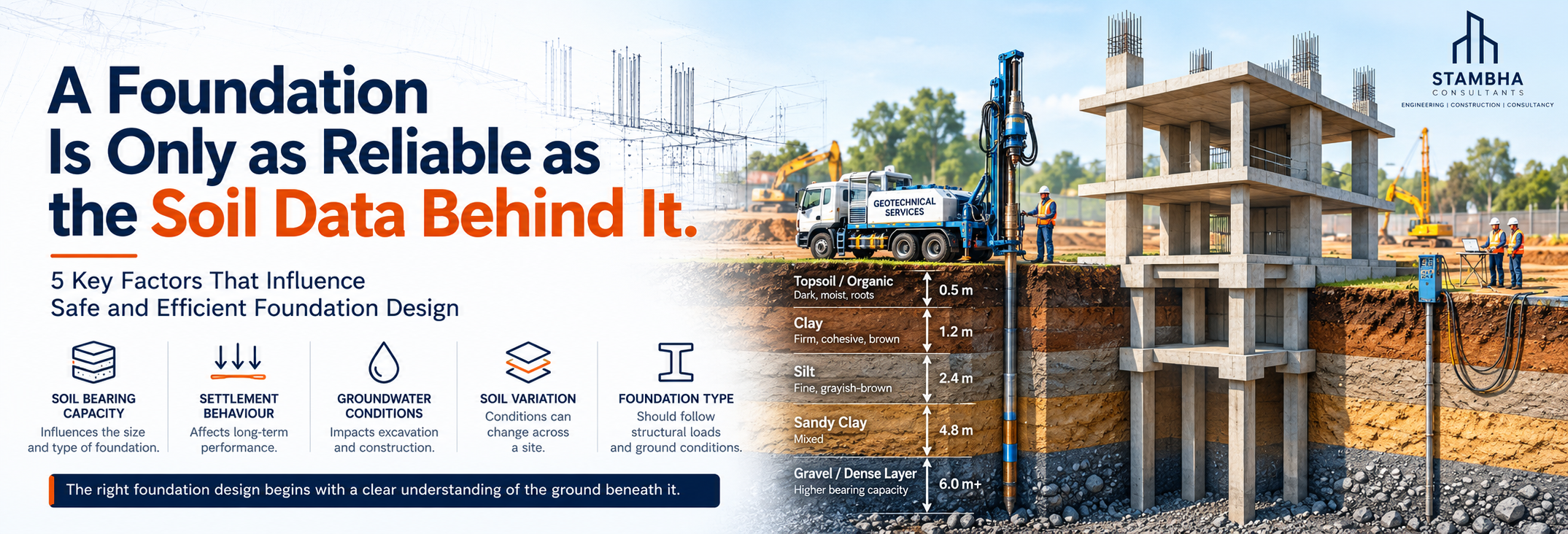
Discover how soil bearing capacity, settlement, groundwater, and site-specific geotechnical investigations influence safe, reliable, and economical foundation design.
Understanding soil bearing capacity, settlement behaviour, groundwater conditions, and geotechnical investigation is essential for reliable foundation design.
A foundation may appear safe on paper and still be unsuitable for the ground beneath it. In structural engineering, a foundation must do more than transfer loads from a building to the soil. It must perform reliably under the actual ground conditions at the project site.
This raises an important question: How confidently can we design a foundation without adequately understanding the soil supporting it?
At Stambha Consultants, we believe that dependable structural design begins with reliable information. Geotechnical investigation is therefore an important part of the foundation design process, helping engineers make informed decisions about foundation type, dimensions, and long-term performance.
1. Why Soil Conditions Matter in Foundation Design
Every structure transfers its loads through columns, walls, and other structural elements to its foundation. The foundation then distributes those loads to the supporting ground.
However, soil is not uniform across every site. Its strength, composition, stiffness, moisture conditions, and depth can vary significantly. These variations influence how a foundation should be designed and how the structure may behave over time.
2. Soil Bearing Capacity
Soil bearing capacity influences the size, depth, and suitability of a foundation. The supporting soil must be able to carry the applied loads without unacceptable shear failure or excessive deformation.
If the available bearing resistance is insufficient, engineers may need to reconsider the foundation dimensions, founding depth, or foundation system.
A reliable assessment of soil properties helps engineers develop an appropriate foundation solution rather than relying on assumptions that may not reflect actual site conditions.
3. Settlement Behaviour
A foundation must not simply resist failure; it must also support the structure without excessive settlement.
Settlement occurs when the supporting soil deforms under structural loads. The amount and distribution of settlement depend on factors such as soil stiffness, compressibility, loading, and subsurface conditions.
Uneven or differential settlement can lead to cracks, distortion, serviceability problems, and additional stresses in structural elements.
Understanding settlement behaviour helps engineers assess whether the proposed foundation can meet the project's performance requirements over its intended service life.
4. Groundwater Conditions
Groundwater conditions can influence foundation construction as well as long-term performance.
Depending on the site, groundwater may affect:
- Excavation stability and the need for dewatering.
- Construction sequencing and foundation installation.
- Soil behaviour and effective stress conditions.
- Durability considerations and protection against water ingress.
Identifying groundwater conditions during geotechnical investigation helps the design and construction teams anticipate site challenges and plan appropriate measures.
5. Selecting the Right Foundation Type
The choice between isolated footings, combined footings, raft foundations, and pile foundations should be based on the structural loads, ground conditions, settlement requirements, and other project constraints.
For example, shallow foundations may be appropriate where suitable near-surface soil conditions and loading requirements permit. Where near-surface soils are unsuitable or settlement cannot be controlled adequately, a deeper or alternative foundation system may need to be evaluated.
The objective is not to select the most complicated foundation system. It is to select a technically appropriate, safe, and economical solution supported by reliable engineering information.
6. Better Soil Data Leads to Better Engineering Decisions
A foundation is only as reliable as the information used to design it.
Insufficient understanding of ground conditions can contribute to unnecessary redesign, cost overruns, construction difficulties, and avoidable structural risks. Conversely, appropriate geotechnical investigation supports more informed design decisions and better coordination between the project’s engineering disciplines.
At Stambha Consultants, we recognise the importance of integrating structural requirements with site-specific ground information when evaluating foundation solutions.
A good foundation design does not begin with choosing between footings, rafts, or piles. It begins with understanding the ground.
Planning a Structural or Industrial Project?
Early coordination between the geotechnical and structural engineering teams can help establish a sound basis for foundation design.
Contact Stambha Consultants to discuss your structural engineering requirements and project-specific foundation design considerations.