Do you detail beam-column joints separately or rely on standard reinforcement continuity?
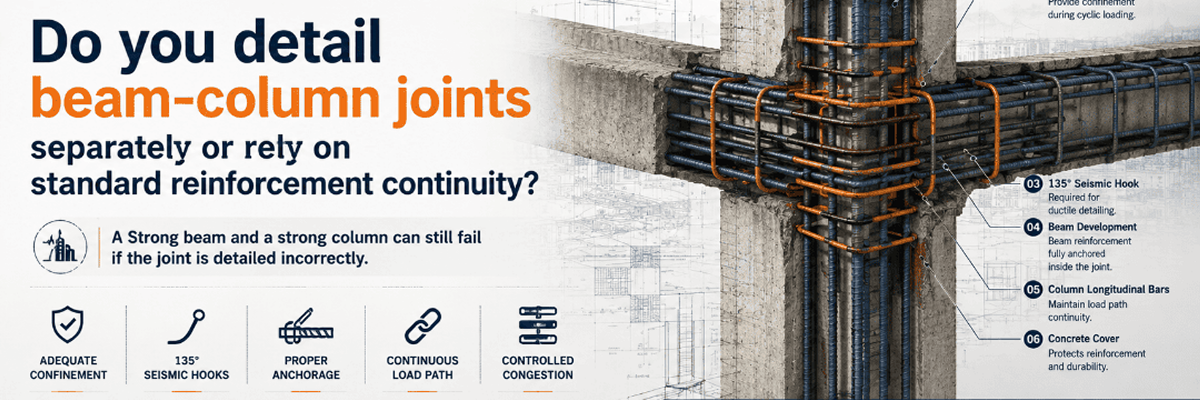
A Strong beam and a strong column can still fail if the joint is detailed incorrectly.
A building can have strong beams. It can have strong columns. And still fail where they meet. That's why structural engineers pay so much attention to the beam-column joint.
During an earthquake, this small region transfers enormous cyclic forces between the beams and columns. If it isn't detailed correctly, the structure may lose its ability to dissipate energy, even when the individual members are adequately designed.
That's why IS 13920 specifies special ductile detailing requirements for beam-column joints.
What this looks like in practice
- Adequate confinement reinforcement
- 135° seismic hooks
- Proper anchorage of beam reinforcement
- Continuous load path
- Controlled reinforcement congestion
One misconception I often come across is that increasing reinforcement automatically makes a structure safer. It doesn't. Seismic performance depends just as much on where the reinforcement is placed and how it is detailed as on how muchreinforcement is provided.
A well-detailed beam-column joint can make the difference between a structure that absorbs earthquake energy and one that suffers brittle failure. When reviewing structural drawings, the beam-column joint is one of the first details I check. Because earthquakes don't only test the strength of a building. They test the quality of its detailing.